
HAIR DENSITY RESTORATION
Hair loss – Alopecia
Alopecia is a hair growth disorder resulting in generalized or localized hair loss. The thinning and loss of scalp hair brings psychological and social consequences to the individuals who experience it, such as low self-confidence, reduced sociability, etc.
It can affect the hair on our scalp or even our entire body.
It is normal to lose 50 – 100 hairs a day out of the approximately 100,000+ hairs we have on our heads. This does not necessarily lead to permanent hair loss, as hair follicles grow individually and fall out in a continuous, cyclical pattern.
It can affect the hair on our scalp or even our entire body.
It is normal to lose 50 – 100 hairs a day out of the approximately 100,000+ hairs we have on our heads. This does not necessarily lead to permanent hair loss, as hair follicles grow individually and fall out in a continuous, cyclical pattern.

Each cycle consists of
4 stages:
Telogen phase:
The telogen phase is a resting period during which hair growth ceases and the hair remains in the follicle without actively growing. It usually lasts 2-4 months.
Exogen Phase:
It is the phase during which the old hair is shed from the follicle, allowing a new hair to begin its growth in the anagen phase. This shedding process is a natural part of the cycle, with individuals losing an average of 50-100 hairs per day.
Anagen phase:
is the period during which the hair develops and grows. This phase lasts 2-8 years.
Catagen Phase:
The catagen phase is a short transitional phase of 2-4 weeks that marks the end of active hair growth. During this phase, the follicle shrinks and the hair detaches from the blood supply, transitioning into a resting state.
Telogen phase:
The telogen phase is a resting period during which hair growth ceases and the hair remains in the follicle without actively growing. It usually lasts 2-4 months.
Exogen Phase:
It is the phase during which the old hair is shed from the follicle, allowing a new hair to begin its growth in the anagen phase. This shedding process is a natural part of the cycle, with individuals losing an average of 50-100 hairs per day.
Anagen phase:
is the period during which the hair develops and grows. This phase lasts 2-8 years.
Catagen Phase:
The catagen phase is a short transitional phase of 2-4 weeks that marks the end of active hair growth. During this phase, the follicle shrinks and the hair detaches from the blood supply, transitioning into a resting state.
Hair loss occurs in many cases immediately after puberty.
The causes of hair loss vary, including genetic predisposition, pathological causes, diseases (such as thyroid), medications, lifestyle (diet, smoking, alcohol), stress, exposure to chemicals, UV rays. It is also important to know that certain types of hairstyles, such as braids, tight ponytails, and hair extensions can cause hair loss.
Hereditary hair loss in men and women is the most common cause of baldness.
The causes of hair loss vary, including genetic predisposition, pathological causes, diseases (such as thyroid), medications, lifestyle (diet, smoking, alcohol), stress, exposure to chemicals, UV rays. It is also important to know that certain types of hairstyles, such as braids, tight ponytails, and hair extensions can cause hair loss.
Hereditary hair loss in men and women is the most common cause of baldness.
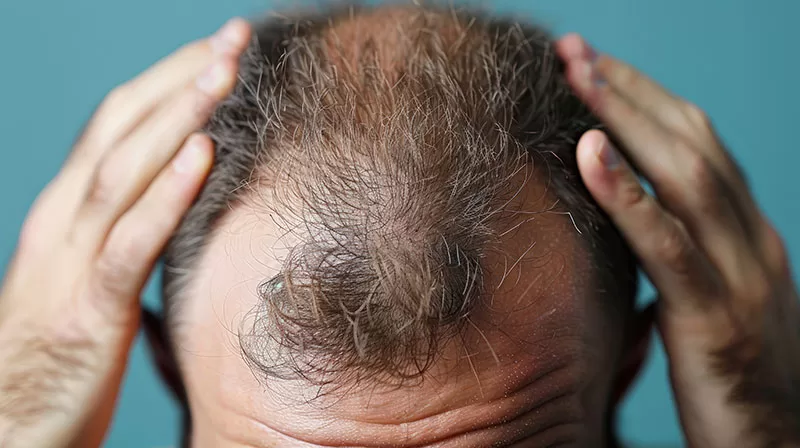
HEREDITARY HAIR LOSS
Androgenetic Alopecia
Androgenetic Alopecia is defined as hereditary hair loss, which results mainly from a genetic predisposition to hair loss but also from hormonal factors, many of which are not yet understood. This form of hair loss is related to hormones called androgens, particularly an androgen called dihydrotestosterone (DHT).
Androgenetic Alopecia is the most common cause of hair loss in men and is responsible for 95% of cases of hair thinning. It is estimated that 60% – 70% of men will experience Androgenetic Alopecia at some point in their lives.
It usually begins with hair thinning and hair loss at the temples and crown and gradual receding of the hairline. Hair follicles affected by Androgenetic Alopecia are permanently damaged. There are treatments that can help delay the process, but hair that has been lost will not grow back.
Androgenetic Alopecia is the most common cause of hair loss in men and is responsible for 95% of cases of hair thinning. It is estimated that 60% – 70% of men will experience Androgenetic Alopecia at some point in their lives.
It usually begins with hair thinning and hair loss at the temples and crown and gradual receding of the hairline. Hair follicles affected by Androgenetic Alopecia are permanently damaged. There are treatments that can help delay the process, but hair that has been lost will not grow back.